Introduction to Ten Pin Bowling
If you have played bowling, especially in bowling centers, most probably you are playing the ten pin variant of bowling. True, bowling almost always refer to the ten pin but ten pin is only one of the many variations bowling is played. There are many variants, actually, like the nine pin, the five pin, candlepin but ten pin bowling is by far the widely played bowling variant.
As the name suggests, ten pin bowling is played using ten pins and knocking these down by the use of balls rolled along a lane. The object is to knock down as many pins possible with the least number of throws. Every bowler is allowed ten frames or turns, with each frame composed of two rolls. If a player manages to knock down a complete set, it is called a strike. But when there are still remaining pins, those that are knocked down are counted and removed.
Then the player has another opportunity to roll a second ball and if he manages to knock all remaining pins then it is called a spare. This process continues until everyone has completed their turns in the frame. After which the game proceeds to the next frame. Bonus points are awarded in case of a strike or a spare.
The pins are arranged in an equilateral triangle, the back row has four pins, the next one has three, and the next has two and the last row (front of the lane, also called the head pin) consist only of one pin aligned at the center. The pins have numberings to ease the references of pins, starting with the single pin in front as one, and ends at ten at the back and rightmost pin. With today’s technology, the pins are automatically set by the machine, unlike before with the usage of ‘pin boys’.
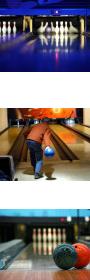
The playing area of ten pin bowling is a straight and narrow surface, known as the lane. Made of usually wooden boards or synthetic material made to look like wooden boards, the ten-pin bowling lane is standard 18.28 meters from the first pin to the foul line. Fifteen feet from the foul line are guide arrows pointing towards the pins and two sets of approach dots are located about 12 ft from the foul line, and another 15 ft for the second set of approach dots.
About The Author
Spoola arts is the
number one
arts, crafts
and hobbies
information site on the internet. Providing information on all ranges of
musical instruments such as the
accordion,
trumpets and a variety of other musical instruments.
|
